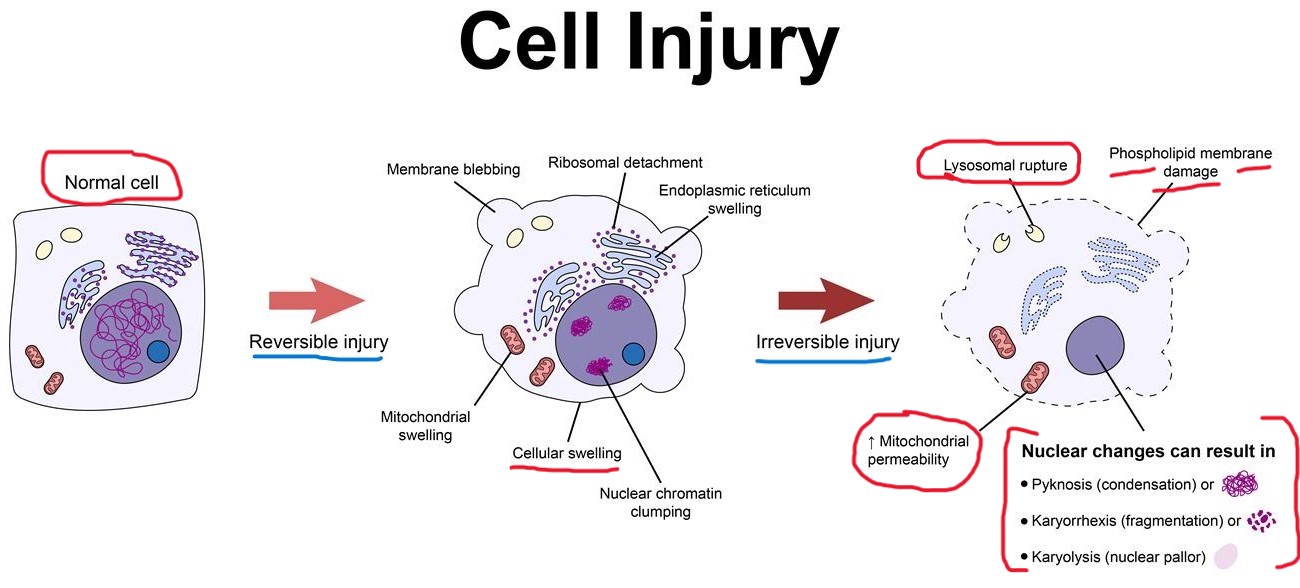
Cell injury :
Cell injury happens due to various reasons. First of all, what do you mean by cell? The cell is the Basic and Main component of tissue in the Body. Tissue is the component that forms organs and from organs, the fully developed Organ system is made. Virchow’s first published cellular theory of disease, Brings the concept that diseases occur due to abnormalities at the level of cells. Since then, studying abnormalities in the structure and function of cells in disease has remained the focus of attention in understanding diseases.
Body cells are divided into two main types:
- Epithelial and
- Mesenchymal cells
Cell injury is simply the effect of a different of stresses due to containing a pathogen ( etiologic agent ) a cell encounters resulting in changes in its environment ( internal and external ). Cells of the body have an inbuilt mechanism to deal with changes in the environment to an extent.
The Cellular Response to Stress may vary and depend upon mainly two factors :
- Host Factors – the type of cell and tissue involved.
- Factor Of injurious agent – extent and type of
cell injury.
Cellular responses to cell injury
-
When there is increased functional demand, the cell may adapt to the changes that are expressed morphologically, which then reverts back to normal after the stress is removed.
-
When the stress is mild to moderate, the injured cell may recover (reversible cell injury), while persistent and severe form of cell injury may cause cell death (irreversible cell injury).
- The residual effects of reversible cell injury may persist in the cell as evidence of cell injury at subcellular level (subcellular changes), or metabolites may accumulate within
the cell (intracellular accumulations).
ETIOLOGY OF CELL INJURY

Cells are mainly injured in two major ways :
- Genetic causes
- Acquired causes
The acquired causes of disease comprise the vast majority of common diseases affecting mankind. Based on the underlying agent, the acquired causes of cell injury can be further categorized as under:
- Hypoxia and ischemia
- Physical agents
- Chemical agents and drugs
- Microbial agents
- Immunologic agents
- Nutritional derangements
- Ageing
- Psychogenic diseases
- Iatrogenic factors
- Idiopathic diseases
more than one of the above etiologic factors may be involved these factors are brief one by one detail.
HYPOXIA AND ISCHAEMIA
Cells of different tissues essentially require oxygen to generate energy and perform metabolic functions. A deficiency of oxygen which is present normally in air or hypoxia results in the failure to carry out these activities by the cells. Hypoxia is a very common cause of cell injury. It Maybe occurs in two ways:
- The most common mechanism of hypoxic cell injury is by reduced supply of blood to cells due to interruption-ischemia
- It may also result from damaged blood supply from causes other than intervention. e.g. disorders of oxygen-carrying RBCs. (i.e. anemia, carbon monoxide poisoning), heart diseases, lung diseases, and increased demand for tissues.
PHYSICAL AGENTS
Physical agents in the causation of disease are
- Mechanical trauma (e.g. road accidents)
- Thermal trauma (e.g. by heat and cold)
- Electricity
- Radiation (e.g. ultraviolet and ionizing)
- rapid changes in atmospheric pressure.
CHEMICALS AND DRUGS
Chemical agents and drugs may cause cell injury. Examples include
- chemical poisons such as cyanide, arsenic, mercury
- strong acids and alkalis
- environmental pollutants
- insecticides and pesticides
- oxygen at high concentrations
- hypertonic glucose and salt
- social agents such as alcohol and narcotic drugs
- therapeutic administration of drugs
MICROBIAL AGENTS
Injuries by microbes include infections caused by bacteria, rickettsiae, viruses, fungi, protozoa, metazoa, and other parasites.
IMMUNOLOGIC AGENTS
Immunity is a ‘double-edged sword’—it protects the host against various injurious agents but it may also turn lethal and cause cell injury e.g.
- hypersensitivity reactions
- anaphylactic reactions
- autoimmune diseases
NUTRITIONAL DERANGEMENTS
deficiency or an excess
of nutrients may result in nutritional imbalances:
- Nutritional deficiency diseases may be due to overall deficiency of nutrients (e.g. starvation), protein calories (e.g. marasmus, kwashiorkor), minerals (e.g. anemia), or trace elements.
- Nutritional excess is a problem of affluent societies resulting in obesity, atherosclerosis, heart disease, and hypertension.
AGEING
Cellular aging or senescence leads to impaired ability of the cells to undergo replication and repair, and ultimately lead to cell death culminating in the death of the individual.
PSYCHOGENIC DISEASES
Biochemical or morphologic changes in common acquired mental diseases due to mental stress, strain, anxiety, overwork, and frustration e.g. depression, schizophrenia.
problems of drug addiction, alcoholism, and smoking result in various organic diseases such as liver damage, chronic bronchitis, lung cancer, peptic ulcer, hypertension, ischaemic heart disease, etc.
IATROGENIC CAUSES
Every physician is bound not to do or administer anything that causes harm to the patient, there are some diseases as well as deaths attributed to iatrogenic causes (owing to physician). Examples include the occurrence of disease or death due to an error in judgment by the physician and the untoward effects of administered therapy (drugs, radiation).
IDIOPATHIC DISEASES
means “of unknown cause”. there still remain many diseases for which the exact
cause is undetermined. For example, the most common form of hypertension (90%) is idiopathic (or essential) hypertension. Similarly, the exact etiology of many cancers is still incompletely known.
- Cell injury is the effect of a variety of stresses due to
etiologic agents a cell encounters resulting in changes in
its internal and external environment. - The cellular response to stress depends upon the type of
cell and tissue involved, and the extent and type of cell
injury. Initially, cells adapt to the changes due to injurious agent
and may revert to normal. - Mild to moderate stress for shorter duration causes
reversible cell injury; severe and persistent stress causes
cell death. etiologic factors, hypoxia-ischaemia is
most important; others are chemical and physical agents,
microbes, immunity, ageing etc.

Leave a Reply